The cosmos of AI for science: everyone agreed on the plumbing, nobody's solved trust
Four scientific workbenches, one open skill standard and the validation layer nobody has built yet, the long read behind Sorting My DNA, Issue 1.
Companion to Sorting My DNA, Issue 1. The Brief gives you the verdicts in a scannable minute. This is the long version, the argument underneath them.
Why I'm doing this
AI is moving faster than anyone can honestly keep up with and the coverage has gotten worse, not better. My feed is full of influencers with two-minute takes on tools they clearly haven't opened, a screenshot, a hot claim, a logo slide, on to the next. For a working scientist trying to decide what's actually worth their time, that noise is expensive. It's not that there's too little information; it's that almost none of it comes from someone who ran the thing.
So I started Sorting My DNA to do the opposite and to hold myself to a method. Here's the process and I mean it literally:
- No AI tool writes this. I read the primary sources myself, the whitepaper, the release notes, the GitHub repo. Not the press coverage, not a summary. The actual documents.
- I run the tool against work I already understand cold, because that's the only way to tell a real capability from a demo. When AlphaGenome shipped, I didn't take anyone's word for it, I wrote a five-part series working through it hands-on. That's the bar.
- Then I curate, in a fixed shape: what it actually is, so what it means strategically, what you can do about it this week, plus the lead (the week's real story) and the connections between the pieces.
It's a deep dive I do over my morning coffee and I publish what survives it. The point isn't to be first. It's to be the read you trust because someone sat with the primary sources and ran the tool before forming an opinion.
I don't come to AI with a side, either. Some people are evangelists, some are doom-mongers; I try to be neither. I look at what shipped, I run it against work I already understand and I let that form the opinion.
Everyone agreed on the plumbing
Over six weeks four scientific "workbenches" arrived, OpenAI's GPT-Rosalind, Google DeepMind's Science Skills, NVIDIA's BioNeMo Agent Toolkit and Anthropic's Claude Science and the easy story to write is a four-way race. That story is wrong. They're not standing in the same place.
The anatomy of an AI system, before we go anywhere
It's worth being precise about the parts, because most confusion in this space comes from collapsing them. The way I think about it:
- The LLM is the brain, the model in the middle.
- Skills are the body's inherent abilities: capabilities packaged so an agent knows how to do something. Easy to write; barely tested, at the moment.
- Tools are the hands and legs: external functions the brain can call to act on the world.
- Connectors are the nervous system: the middleware bridging the brain to the tools.
- Compute and orchestration are memory and decision-making, how the whole thing holds state and decides what to do next.
- And underneath all of it, the silicon: the chips everything runs on.
Frameworks like LangChain (I wrote about the agent-building toolkit here) made it practical to wire these together. Hold that anatomy in mind, because the four players I care about have each planted a flag at a different layer of it and that's the whole point.
Different positions, not the same race
Line them up by where they actually sit:
NVIDIA builds the foundation, the silicon and a decade of accelerated bio models exposed as agent-callable tools. At BIO26 they said the quiet part aloud: "We're not even building agents. These are the tools we provide to agents and it's agent-agnostic." That's not modesty, it's strategy. Whoever's workbench wins, the tools underneath are NVIDIA's, sold on NVIDIA's GPUs. Look at their ecosystem slide, Schrödinger, Benchling, Recursion, Thermo Fisher, Seqera, all of it building on top. The arms dealer wins either way.
Arc Institute sits one layer up and this is the part people miss: the models doing the actual biology inside everyone's toolkit are open and academic. Evo 2, 40 billion parameters, peer-reviewed in Nature, open weights, is a callable NIM inside BioNeMo, which Claude Science calls. So an open model from a non-profit is upstream of all three commercial products. Open isn't the sideshow. It's the substrate.
Google DeepMind trains foundational models (AlphaFold, AlphaGenome) and, alone among the four, shows its work. When they released Science Skills they published a whitepaper: unit tests, workflow tests, an internal benchmark, an external one, quantified token savings and a section on limitations. My favourite result in the whole paper is buried in the appendix. Asked whether ACE2 is detected in the duodenum and thyroid gland, the bare agent scraped the Human Protein Atlas, UniProt and tellingly... Wikipedia across eleven steps, hit real but noisy signals and reasoned its way to the wrong answer: "detected" in the thyroid, off a low baseline RNA reading. The same agent with the Science Skills bundle resolved the gene's Ensembl ID and made one structured query to the Human Protein Atlas, four steps, no web scraping and returned the curated, correct answer: not detected. That's not a model hallucinating from nowhere. It's a model without grounded tooling drawing a plausible, confident, wrong inference from messy public data, the exact failure mode that should scare a bench scientist. The tooling didn't make it smarter; it made it grounded. Compare it to the industry default, slap the logos of every company that tested your product on a slide and gate-keep the actual numbers. In a field that runs on peer review, showing your work isn't a nice-to-have. It's the credibility game and only one of them is playing it.
Anthropic bets on the workbench and the connectors, how tools interface with skills and how a scientist actually drives the whole thing. I used Claude Science the day it launched. I handed it candidates from a very sophisticated pipeline, work done entirely pre-AI, no AI anywhere in the original process and asked it to find novel candidates, list the resources it searched to justify their novelty, explain why each was viable and propose assays to validate them. It did a mind-blowing job. Not because the model got smarter, but because the eleven-tool slog between question and answer collapsed into one agent, with a reproducibility trail attached.
OpenAI builds the whole gated ecosystem, its own model, its own plugins, its own workspace. GPT-Rosalind is the mirror image of Claude Science: they did build a bespoke model and they defend it behind a qualification wall.
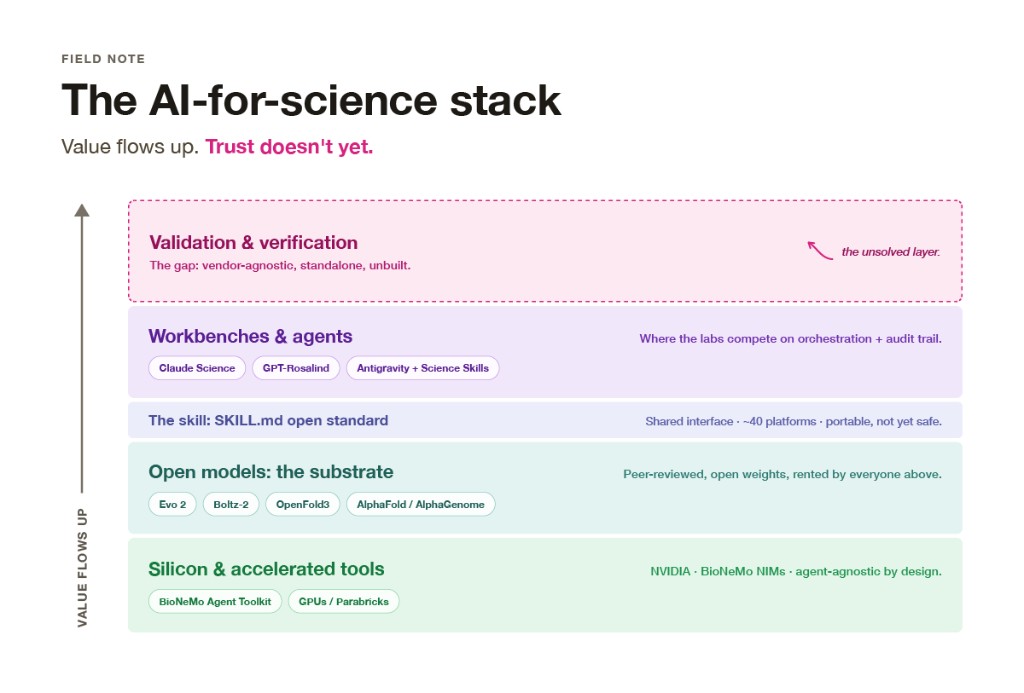
Five players, five layers. Not a race, a stack.
The thing they all quietly agreed on
Here's what makes this a moment rather than four separate announcements. Under the positioning, they converged on one primitive: the skill. Anthropic published SKILL.md as an open standard in December 2025 and within months ~40 platforms adopted it, OpenAI's Codex, Google's Gemini CLI, Microsoft's Copilot and on down the list. A skill written once runs, unmodified, across competing agents. BioNeMo's skills drop into Claude Code and Codex alike.
That interoperability is real and it's genuinely good for a working scientist: the model layer is becoming interchangeable plumbing. You are no longer buying a model. You're buying orchestration, compute and the part that matters in a regulated environment, an audit trail.
But portability spread faster than quality did. A security audit found prompt injection in 36% of skills tested. Average skill quality, in one analysis of tens of thousands of public skills, scored 6.2 out of 12. A skill that runs everywhere can also carry a flaw everywhere. Distribution is solved. Trust is not.
The gap: validation wants to be its own company
This is the argument I actually want to make and it's why I titled the issue the way I did.
Every one of these systems can now produce a scientific result, find the candidate, fold the protein, draft the manuscript. What none of them has solved is proving that result is sound and reproducing it later for someone who wasn't in the room. Anthropic's Claude Science comes closest, with a reviewer agent that checks citations and calculations. But that reviewer runs on the same underlying model as the work it's checking. It's the model marking its own homework. Useful, but it is not the independent verification a regulator will eventually demand.
I think the validation and verification layer has to work on two fronts at once. On the scientific side: is this actually sound?, checked against benchmarks, literature and experimental ground truth. On the regulatory side: can you prove to an auditor exactly what happened and why?, audit trails, decision rationale, reproducibility. These two pull against each other. Scientific exploration wants speed and flexibility; regulatory compliance wants documentation and standardization. The real prize is a system that does both without strangling the discovery process, automation doing the heavy lifting (running the checks, gathering evidence, flagging anomalies, surfacing confidence, pulling the relevant literature) and presenting it to a human expert who stays in control but isn't buried in busywork.
And I think that layer should be standalone and vendor-agnostic, not built inside any one model company. Here's the reasoning. If each frontier lab builds its own validation, you get fragmented checkers that don't talk to each other, each blessing its own outputs. A vendor-neutral layer would sit across Claude, GPT and Gemini alike, it becomes the connective tissue. Validation in pharma is also specialized enough that it deserves focused expertise, not to be feature number nine inside a foundation-model company whose real incentive is to make its own outputs look trustworthy. It's the same logic NVIDIA is running one layer down: don't build the whole stack, build the piece everyone needs and let the rest plug into you. Whoever ends up owning that layer, the structural point holds, it can't credibly be the same company whose outputs it's checking.
What would it need? FDA guidance as the floor. Historical drug-development data, the pipelines that worked, the trials that failed and why. Peer-reviewed literature to check against. Real-world adverse-event data. And, hardest of all, proprietary validation knowledge from pharma companies themselves, what they've learned works and doesn't, which is exactly the data nobody wants to hand over. That last one is the moat and the obstacle at the same time.
I don't think anyone has deeply solved this. The verification layer is the bottleneck to closing the loop and it was comparatively easy in code, where tests are cheap and truth is checkable, but it is not trivial in biology, where the ground truth is a wet-lab experiment that takes months. That difficulty is precisely why it's worth building. (It also needs a collaboration layer alongside it, but that's a separate post.)
What I'd tell a bench scientist to do this week
Not theory, actions:
- Run them yourself. The only way to tell hype from reality is to hand each one a task you already understand cold and judge the output. I did this with Claude Science and it changed my read.
- Use the open substrate as leverage. Pull Evo 2, score a variant where you hold ground truth and check what the gated products promise against what the open model actually does. That's your negotiating position and your reason not to lock your data into anyone's cloud.
- Treat DeepMind's whitepaper as a template. Its evaluation section is the clearest published example of how to benchmark an agentic scientific tool honestly. Read it before you believe anyone's numbers, including OpenAI's, whose Rosalind wins its benchmarks against GPT-5.5 but still scores in the low 20s on the hard agentic tasks. "Beats the other frontier model" and "reliable enough to trust unsupervised" are very different claims.
- Audit the auditor. If a tool checks its own work with the same model, find out where that breaks before you rely on it.
The capability is here. Agentic AI arrived in software, the GitHub numbers show it and it's coming for science now. What's missing isn't intelligence. It's the layer that lets a regulated field trust what the intelligence produced. That's the gap, the one layer nobody has built and the one that can't credibly live inside any single model company.
, Parul Kudtarkar
Read the verdicts in brief at Sorting My DNA, Issue 1.
Sources
Everything below I read or ran directly. Primary sources first, the announcements, whitepapers and repos, because that's the whole point.
Anthropic · Claude Science
- Claude Science, an AI workbench for scientists (announcement)
NVIDIA · BioNeMo Agent Toolkit
- BioNeMo Agent Toolkit (GitHub repo)
- BIO26 Healthcare Special Address (keynote, the launch announcement)
- NVIDIA Healthcare & Life Sciences (ecosystem)
- Build an AI Scientist for Life Science Discovery with NVIDIA BioNeMo Agent Toolkit (developer walkthrough)
Google DeepMind · Science Skills
- Science Skills for Antigravity: Towards Efficient and Reliable Scientific Workflows (whitepaper, PDF)
- google-deepmind/science-skills (GitHub repo)
OpenAI · GPT-Rosalind
- Introducing GPT-Rosalind (April 2026 launch)
- Introducing new capabilities to GPT-Rosalind (June 2026 update)
Arc Institute · Evo 2
The skill standard
- agentskills.io, the open SKILL.md standard
My earlier work referenced here
- The essential toolkit for building AI agents (2026)
- My AlphaGenome series, the five-part hands-on walkthrough
Note on method: I read the primary sources and, where possible, ran the tools myself before forming any view. No AI system wrote this analysis. Where I've cited a benchmark number or a claim, it comes from the linked source above, check it against your own use case rather than taking mine.