
Game Theory Didn't Change How I Think. It Named What I Was Already Doing.
Five principles from Dixit and Nalebuff's The Art of Strategy and how they already show up in genomic data infrastructure, research bets and model trust.
I have a physicist friend and whenever I bring him a life situation, his response is never really an answer. It's an algorithm. A formula. A concept borrowed from physics that, on the surface, has nothing to do with what I just told him.
Sometimes I roll my eyes. Sometimes I shake my head. Occasionally I scratch my head, genuinely unsure how representing a quantum system as a network of compressed mathematical tensors applies to whatever I just told him about my week. And then, a few minutes later, almost against my will, I think about what he actually said and it's uncomfortably complete. The question. The answer. The thing I hadn't considered yet. All folded into one elegant, slightly annoying observation.
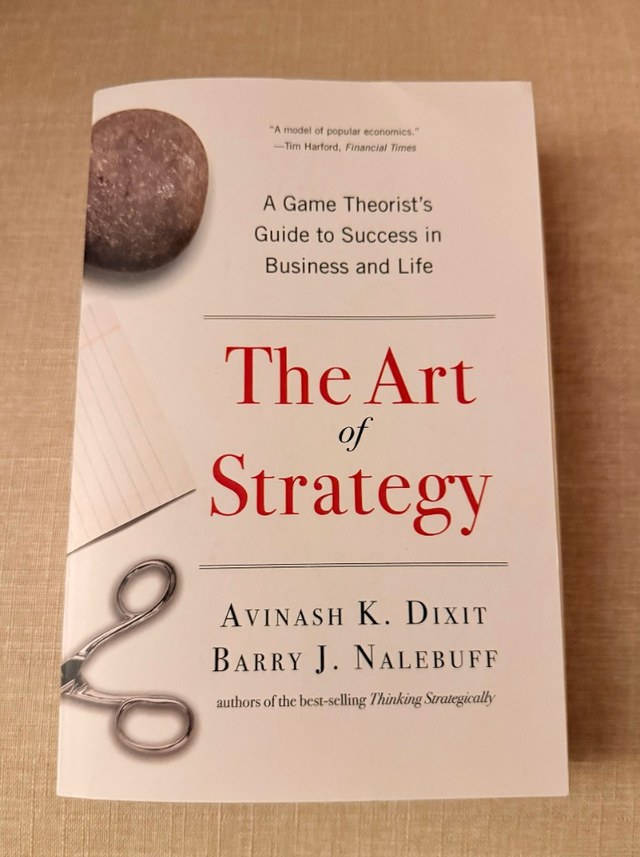
That's roughly how I felt the first time I opened The Art of Strategy by Avinash Dixit and Barry Nalebuff. It is a framework that is everywhere, in hiring decisions, in relationships, in the exact kind of genomic data and computational biology problems I deal with every week.
And it turns out, bioinformatics has been quietly borrowing from game theory for years. Shapley values, now standard for attributing credit across features in ML models through tools like SHAP, came directly from cooperative game theory. Nash equilibria appear in protein folding models, where residues negotiate stable configurations the way players settle into optimal strategies. The math was already in the field. Most people using it don't know where it came from.
The book's premise is simple: most situations that matter are games. Not in the trivial sense. In the precise sense. There are players. There are choices. Every player's outcome depends not just on what they decide but on what everyone else decides too. And most people are playing these games without ever naming the board they're standing on.
Here are five principles from the book that I would pin. Each one is something genomics and computational biology teams do every week by instinct. The vocabulary is what turns instinct into a decision you can actually defend.
Start From the Endpoint, or the Endpoint Will Start With You
Backward induction is the least intuitive discipline in building genomic data infrastructure, because infrastructure gets built forward. You acquire the cohort. You standardize the pipeline. You run the QC. You make the data browsable. Each step follows from the one before and a platform that loads correctly feels like progress.
Backward induction inverts that entirely. You begin at the decision a researcher actually needs to make using the resource, the causal variant they need to prioritize, the regulatory mechanism they need to confirm, the therapeutic target they need to defend in a committee meeting and you walk it back, step by step, to the data architecture sitting in front of you today.
Don't ask what this dataset can support next. Ask what decision this platform must enable and what that forces you to build right now.
Here's where teams get hurt. A genomic atlas optimizes for breadth, more tissue types, more assays, more samples, because breadth is the number that climbs and feels like progress. Reasonable forward. But reason backward from a researcher who needs to confidently link a single non-coding variant to a specific gene's expression change and breadth without consistent QC standards across samples is worse than no atlas at all. The mismatch surfaces only after a partner has built months of downstream analysis on top of data that turns out to be inconsistently processed. The endpoint requirement, what decision this has to support and how rigorously, was knowable on day one.
Backward induction is how you find the architectural flaw before someone else builds their science on top of it.
Nobody Quits the Race Alone
Three companies are chasing the same target. All three know it's crowded. All three privately suspect the market won't reward whoever lands third. All three keep spending.
This looks like irrationality from the outside. It isn't. It's a Nash equilibrium, a state where every player is making the best move given what everyone else is doing and no single player can improve their position by changing strategy alone.
The trap is in that last word. Alone. Any sponsor who unilaterally drops out absorbs the full sunk cost and hands the field to rivals. So nobody drops. The stable outcome is three companies overspending on a race that will disappoint at least two of them and it's stable precisely because it's painful for everyone and unbreakable by anyone acting solo.
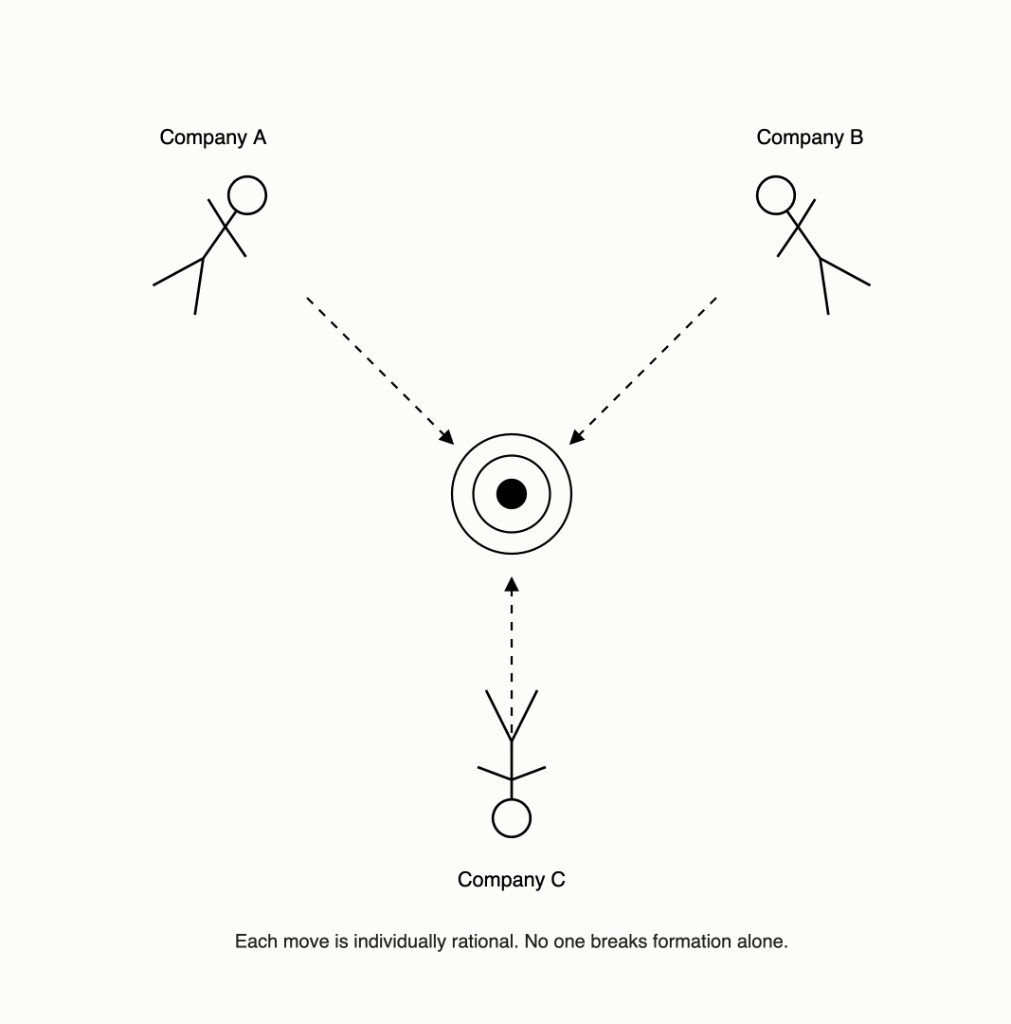
Knowing you're in a Nash equilibrium doesn't tell you to quit. It tells you something more useful: stop waiting for the others to blink. They won't, for exactly the same reason you won't. If the position is untenable, the exit has to be a deliberate decision made against the equilibrium. Not a hope that the game dissolves on its own.
The Capability That Wins Regardless of Which Program Survives
Most research infrastructure bets are conditional. If this disease program matters, this investment pays off. Dominant strategies are the rare moves that pay off regardless, the best choice no matter what else happens on the board.
They're worth hunting for deliberately, because they're calm in a way conditional bets never are.
A genomics team deciding whether to build standardized, reusable infrastructure, automated QC frameworks, documented onboarding patterns, pipelines that work the same way across cohorts, faces this choice constantly. The conditional thinker asks which specific disease program will need it and bets accordingly. The dominant-strategy thinker notices something better: the right infrastructure accelerates every program that comes after it, sharpens every quality decision and survives even when any single initiative loses funding or stalls. It's the right investment if the current program succeeds. It's the right investment if it doesn't.
That's what makes it dominant.
The discipline isn't finding clever bets. It's recognizing which choices stop depending on which specific program wins and building those first, because they're the only ones that don't require being right about the future.
The Strongest Move Is the One You Can't Take Back
Every multi-partner data initiative has a version of this problem: the data quality bar that quietly erodes. A sample looks borderline. A partner is eager to move forward. It's easier to make one exception than to hold the line and one exception becomes the precedent for the next.
The fix isn't vigilance. It's a credible commitment.
Before the data arrives, while everyone is still reasonable and nothing is yet at stake, you set a hard QC threshold. A pre-specified standard: samples below this bar don't make it into the released dataset, no exceptions, regardless of whose sample it is or how much work went into collecting it. The power of the commitment comes entirely from its irreversibility. A soft intention to maintain standards collapses the moment a borderline sample belongs to an important collaborator, which is precisely how quality erosion happens, one reasonable exception at a time.
A commitment made binding in advance removes the future wiggle room that future-you will desperately want to use.
This is the counterintuitive move at the heart of credible commitments: you strengthen the resource by removing your own discretion. The same logic applies to partner negotiations. A team that has pre-committed to documented performance thresholds and release timelines negotiates differently than one that quietly reserves the right to make case-by-case calls. The standard only works if it can't be quietly bent.
Set the bar early. It's the cheapest discipline available and the hardest to actually hold.
What You Do Is Louder Than What You Claim
In any collaboration, one side knows something the other doesn't. A team claims their model is robust. A developer claims their validation is rigorous. Everyone has an incentive to claim the flattering version and talk is cheap. So real information moves through actions that would be too costly to fake.
That's the pairing: signaling and screening. Two sides of the same coin.
Signaling is what you do to credibly reveal what you know, when words alone won't be believed. A team that documents a model's validation methodology, its failure modes and its performance boundaries in a formal model card or technical file, before any regulator or partner asks for one, is sending a message that a confident verbal pitch never can. Producing that documentation costs real effort and creates a permanent record that can later be checked against reality. A team with a weak model has every incentive to keep things informal and verbal, where claims are easy to make and hard to pin down. A team with a strong model can afford the paper trail, because the paper trail is exactly what holds up under scrutiny.
Screening is the mirror. A regulatory body that requires AI developers to submit a structured risk assessment before a model can be deployed in a clinical decision pathway is running a screen. A team confident in their model's safety profile accepts the requirement and submits. A team that privately knows their validation is thin pushes back, requests exceptions or quietly pivots to lower-scrutiny use cases. The requirement does the sorting without anyone having to say which kind of team they are.
But screening isn't confined to regulatory submissions. It runs quietly through hiring too. A credential requirement is a screen, a proxy a busy reviewer uses when they can't directly observe whether someone can actually do the job. Screens are efficient until they decay. They stop tracking the trait they were designed to measure and start tracking themselves. When that happens, demonstrated capability doesn't clear the filter, not because the depth isn't there but because it arrived through a different path than the screen was calibrated for. The filter keeps running. It just stopped sorting for the right thing.
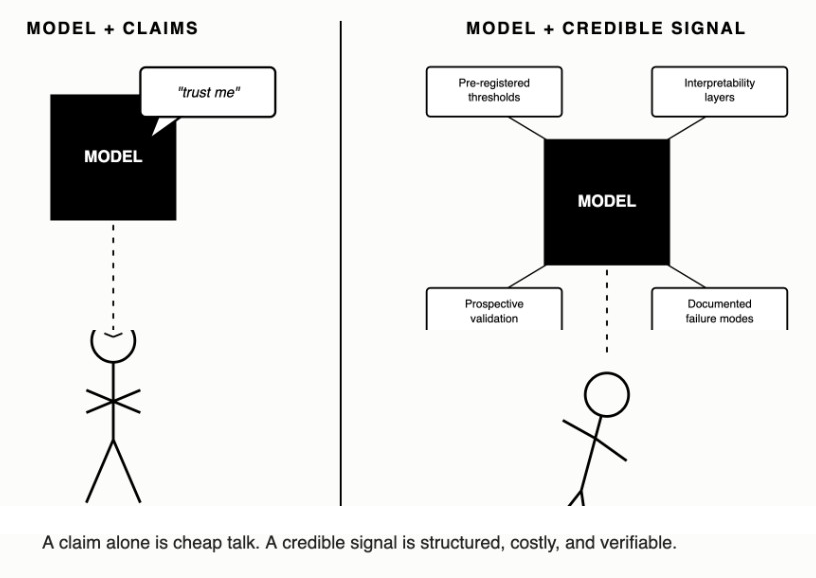
The documentation a team produces before anyone demands it. The risk assessment a regulatory process requires before granting deployment. The credential a hiring process uses as a proxy for depth it can't be bothered to verify. These aren't logistics. They're statements, made in the only language that can't easily lie: cost. And the question worth asking is whether that cost is still tracking what it was meant to measure.
The atlas built for breadth instead of the researcher's actual decision. The infrastructure investment nobody made because it didn't belong to one program. The data standard that almost bent for the wrong reason. The model that never made it past the skepticism in the room.
None of these felt like strategy when they were happening.
Game theory doesn't introduce new decisions. It ends the illusion that you weren't already making them. And that's the difference between a move you stumbled into and one you chose.
Somewhere in your organization, someone is deciding, formally or by default, whether a model is trustworthy enough to act on. Which of these five games are they actually playing and do they know it?